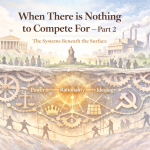
When There is Nothing to Compete For - Part 2
This book does not begin with Plato, Aristotle, Hobbes, Marx, or Rawls. Yet everything they struggled to understand lives quietly within its pages
Loading...


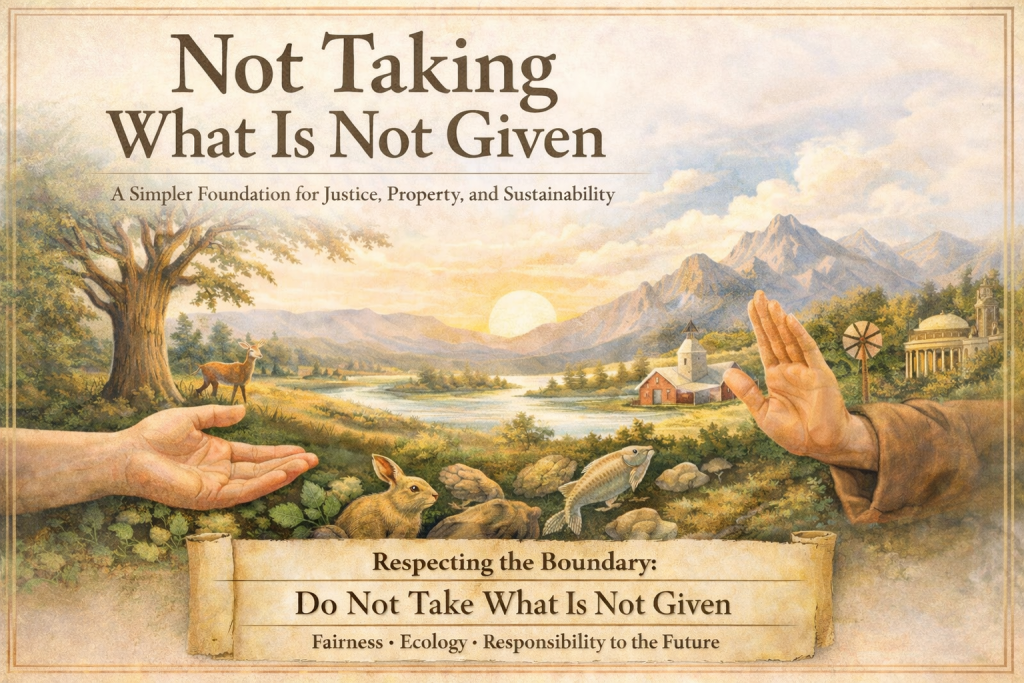
Political philosophy has long relied on complex theories to explain justice, freedom, and the purpose ofthe state. Yet many of these theories remain in conflict because they rely on different interpretations ofreason. This essay explores a simpler foundation for political and economic order: the ancient principleof not taking what is not given.
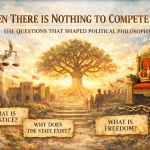
For centuries, political philosophers and economists have asked enduring questions: What is justice?
What is freedom? Why does the state exist? How should resources be shared among people, and who
decides? From Plato and Aristotle to Hobbes, Locke, Rousseau, Marx, and Rawls, brilliant systems have
been constructed to answer these questions. Yet, despite centuries of thought, human societies
continue to struggle with inequality, environmental destruction, and political conflict.
The difficulty may not lie in a lack of reasoning, but in the absence of a simple principle universally
recognized: a principle within which reasoning can reliably operate. Modern political thought, shaped by
the Enlightenment, placed extraordinary confidence in human reason. Thinkers such as John Locke
believed that rational individuals could discover universal principles for a just society. The Enlightenment
project celebrated liberty, scientific inquiry, and the capacity of reason to uncover truth.
Yet even in the Enlightenment, reasoning rested on assumptions that were not universally accepted.
While Locke argued for natural rights and property derived from labor, he also recognized limits,
introducing the idea that appropriation must leave “enough and as good” for others (1). Montesquieu
emphasized separation of powers to prevent tyranny (2), and Rousseau highlighted the social contract
as the basis for legitimate government (3). These frameworks laid the foundations of modern liberal
democracy.
However, the practical application of these ideas often diverged from natural and ethical realities.
Ownership of land, monopolization of resources, and economic policies sometimes allowed individuals
or groups to claim more than what nature or society had given them, creating imbalance and conflict.
Even liberal systems, built on liberty and equality before the law, can reproduce inequities when natural
resources are treated as private property rather than a shared inheritance.
The 20th century brought further reflection. Modernism, a continuation of Enlightenment confidence,
maintained that reason and science could progressively improve society. It assumed that institutions,
laws, and policies, if rationally constructed, would lead to fairness and progress. Yet modernist
confidence sometimes ignored practical limits and ethical boundaries, producing systems that appeared
rational but perpetuated harm.
Postmodernism emerged in part as a critique of this overconfidence. Philosophers such as Michel
Foucault and Jean-François Lyotard argued that reason itself is shaped by historical, linguistic, and
power structures. What one group calls rational, another may see as ideological. Postmodernism
questions the universality of reason, highlighting conflicts that arise when abstract frameworks fail to
reflect lived realities.
In both cases—modernist and postmodernist—the struggle continues because there is no universally
accepted boundary for reasoning. Political and economic theories become competing belief systems
rather than tools for solving human problems. In this sense, we are not fundamentally different from
societies that once relied solely on divine or metaphysical authority to determine legitimacy. As Alasdair
MacIntyre observed, political theory often focuses more on argumentation than on discovering the right
answers(4).
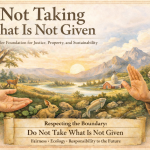
Here, a simple principle emerges with remarkable clarity: not taking what is not given. This principle is
older than philosophy itself. Across human history, societies have recognized that survival, coexistence,
and harmony require restraint in claiming what does not belong to one. Ancient moral traditions,
expressed in proverbs, customs, and ethical precepts, consistently warn against theft, usurpation, and
the taking of what is not rightly possessed.
In the teachings of Gautama Buddha, refraining from taking what is not given is not only ethical but
rooted in the natural order of all existence. Humans are part of nature, living alongside other
beings—plants, animals, ecosystems—that share the world with us. Land, water, forests, rivers,
minerals, and all living beings were not created by any individual. Claiming exclusive control over them
without consent disrupts the balance that sustains life.
Human creativity is fully recognized within this principle. Individuals are free to innovate, build, create
businesses, develop skills, and transform materials. These are the products of human labor and
intelligence, and their ownership is justified. Nature, however, and the beings within it, remain part of a
shared inheritance. Taking from this inheritance without consent violates both ethics and the logic of
coexistence.
The principle is not merely moral—it is logically unavoidable. If humans are part of nature and no
individual created certain resources or life itself, any claim of absolute ownership without the consent of
others violates an unavoidable reality. Denying this principle produces imbalance and conflict, no matter
how elegant a theoretical system may be.
Applying this principle reshapes political and economic institutions:
Property: Ownership is limited to what humans create. Natural resources and all living beings
are part of the shared environment and cannot be claimed absolutely.
Taxation: Compensation for using natural resources becomes a moral and legal requirement,
not merely a fiscal measure.
Sovereignty: The state is not the owner of resources but the guardian of society’s natural
inheritance. Its duty is not only to ensure that the use of nature does not deprive others or
disturb ecological balance. It must also ensure that the value of nature is preserved and
enhanced so that the inheritance passed on to future beings is not diminished but enriched.
This framework dissolves the traditional conflict between capitalism and socialism. Capitalism defends
private ownership but risks capturing natural wealth. Socialism attempts equality but often suppresses
individual initiative. A system guided by the principle of not taking what is not given allows creativity to
flourish while protecting natural resources as a shared inheritance.
The beauty of the principle lies in its simplicity and universality. It resonates because it is already
embedded in human moral consciousness. It does not rely on contested theories of justice, happiness,
or historical inevitability. Once accepted, reason operates within its boundaries to design institutions
that are both fair and sustainable.
Moreover, the principle unites moral intuition with political practicality. Where Enlightenment thinkers
proposed systems that sometimes divorced reasoning from natural reality, and where modernist and
postmodernist debates struggled with the authority of reason itself, this principle provides a clear,
undeniable foundation. Political legitimacy, economic fairness, and ecological harmony emerge naturally
from its consistent application.
In essence, the principle of not taking what is not given is not a new invention. It is the rediscovery of a
truth long recognized by human societies, now extended to political and economic organization. By
placing it at the foundation of governance, we allow freedom, fairness, and ecological balance to
coexist, offering a framework where human reason can finally solve enduring problems rather than
merely argue about them.
Notes:
1. John Locke, Second Treatise of Government (1689).
2. Montesquieu, The Spirit of the Laws (1748)
3. Jean-Jacques Rousseau, The Social Contract (1762).
4. Alasdair MacIntyre, After Virtue (1981)
Lumbini Priyantha Devasirie
March 2026

This book does not begin with Plato, Aristotle, Hobbes, Marx, or Rawls. Yet everything they struggled to understand lives quietly within its pages
This essay begins with a simple observation. Despite the many systems we have created to bring order, justice, and peace, conflict continues to return in different forms. Rather than searching for new solutions within the same patterns, it invites a different inquiry. It asks whether the way we understand ourselves and our relationship to others may be the very ground from which these problems
This collection of essays began as an attempt to pay tribute to Dr. Gunadasa Amarasekara. At the time, the intention was simple and sincere: to acknowledge a thinker who devoted his life to examining the Sinhala Buddhist consciousness from within, not as an observer standing outside society.