When There is Nothing to Compete For - Part 2
This book does not begin with Plato, Aristotle, Hobbes, Marx, or Rawls. Yet everything they struggled to understand lives quietly within its pages
Loading...


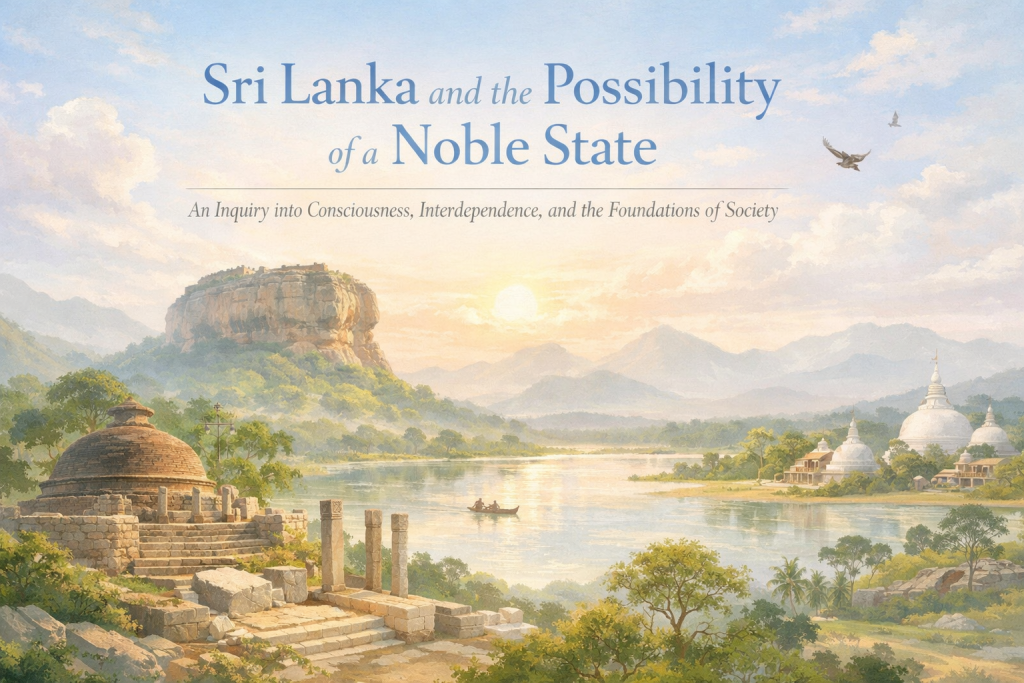
This essay begins with a simple observation. Despite the many systems we have created to bring order, justice, and peace, conflict continues to return in different forms. Rather than searching for new solutions within the same patterns, it invites a different inquiry. It asks whether the way we understand ourselves and our relationship to others may be the very ground from which these problems
An Inquiry into Consciousness, Interdependence, and the Foundations of Society
Every political system begins with a promise. Some promise freedom, others equality, some order, prosperity, or justice. From the city-states of Ancient Greece to the modern nations shaped by thinkers such as John Locke and Jean-Jacques Rousseau, the pattern has been consistent: a vision arises, a structure is built, and for a time it appears to work.
Yet over time, each system strains. Inequality reappears where equality was promised. Power concentrates where it was meant to be distributed. Conflict emerges where harmony was expected. The system is then reformed, replaced, or overthrown. The cycle begins again.
Traditional explanations (corrupt leaders, ignorant citizens, inefficient institutions, external enemies) address surface symptoms but not the root. To see the root, one must examine the starting point: the assumption that human beings exist as separate individuals with independent interests. From this assumption, all political conflicts flow. Competing interests, resource allocation, and power struggles are inevitable. Every ideology, every system, operates within this frame. Whether liberalism, neoliberalism, modernism, postmodernism, or even the clashes of civilizations described by Samuel P. Huntington, the underlying movement is the same: separation, scaled from the individual to the collective.
And yet, there is another layer to this understanding. It is the inner layer that has rarely been made conscious. William James described consciousness as a continuous stream, not a collection of separate parts. Within this flow, the “I” emerges moment by moment. It is not a fixed entity, but a process formed and sustained by the movement of thought itself. From this center, separation arises naturally: what is “mine” and what is “other,” what is “us” and what is “them.”
This formation is largely unconscious. The sense of self feels solid, real, and inevitable. Interdependence, though ever-present, is invisible. Even the most intelligent and thoughtful people operate within this inherited structure, refining, adjusting, and debating, yet never seeing the root of separation itself.
Here lies both the challenge and the opportunity. Attention to the flow of thought (observation of how the “I” forms within consciousness) can transform perception. When the movement of separation is observed, its rigidity loosens. Boundaries between self and other, between group and group, begin to dissolve. Interdependence moves from being an abstract idea to a directly experienced reality.
From this perception arises the foundation of the Noble State; the Arya Rajya. Not imposed externally by law or authority, not taught through doctrine, but emerging naturally from the way consciousness itself is understood. Conflict, once inevitable, is no longer a structural necessity. Relationships, resources, and power can be aligned with the flow of interdependence, not opposed to it.
Nowhere is this more feasible than in Sri Lanka. Its Theravada Buddhist tradition, practiced and absorbed over centuries, has left an imprint in the collective consciousness. This is what Gunadasa Amarasekara calls Jathika Chinthanaya: a national way of thinking shaped by culture, tradition, and lived experience. People may live like anyone else, pursuing ordinary goals and desires, yet beneath the surface lies a subtle readiness—a sensitivity to interdependence and the unfolding of experience. This does not confer moral superiority, but it does make the consciousness more receptive to a Noble State. The patterns of thought that sustain separation are easier to see, and interdependence can move into awareness with less effort.
This is the extraordinary possibility: the same stream of consciousness that creates division at the individual level can, when observed, produce understanding at the societal level. The expansion of the “I” into “we,” then “us” and “them,” no longer produces inevitable conflict. It becomes a natural field in which the Noble State can arise—not as an abstract ideal, not as a utopian project, but as an emergent reality of consciousness made conscious.
In this way, Sri Lanka offers a living laboratory for this transformation. The flow of thought, the formation of the “I,” the expansion of collective identity, and the recognition of interdependence converge to create the conditions for a state that does not merely manage division, but transcends it. The Noble State begins in the mind, ripples into relationships, and shapes the structures of society, arising naturally from the awareness of what has always been there but rarely seen.
This is not distant or impossible. It is subtle, patient, and experiential. And once the stream of consciousness is recognized, the patterns of separation no longer dominate. Interdependence becomes visible, and from that, the possibility of a society rooted in harmony, awareness, and balance emerges. The Noble State, here, is quietly possible.
01. Beyond Renaissance and Enlightenment: A Different Beginning
This inquiry does not begin where most political thought begins.
It does not begin with Plato, nor with Aristotle. It does not take its first step from the Renaissance, nor does it anchor itself in the Enlightenment. Yet everything these traditions struggled to understand is quietly present within it.
To see this clearly, one must first understand what the Renaissance and the Enlightenment truly achieved.
The Renaissance, born in the city of Florence, was a turning of the human gaze. After centuries of looking upward toward divine authority, man began to look around and within. The works of ancient Greece and Rome were rediscovered, not merely as history, but as living possibilities. Art, science, and literature flourished, and with them emerged a quiet but powerful idea: that the human being is capable of knowing, creating, and shaping the world. This was not yet a rejection of authority. It was a rediscovery of confidence.
The Enlightenment, which followed, took a further step. It asked not what man can create, but how man can know. Thinkers such as John Locke, Voltaire, and Jean-Jacques Rousseau sought to establish reason as the final authority. Tradition was questioned, monarchy was challenged, and the idea of rights, liberty, and equality entered political life with force. If the Renaissance opened the human mind, the Enlightenment attempted to discipline it.
From these two movements emerged the modern world. Constitutions were written, institutions were built, and systems of governance were justified on the basis of reason and individual rights. It is within this framework that nearly all contemporary political thought still operates. And yet, something remained unquestioned.
Both the Renaissance and the Enlightenment begin from the same silent assumption: that the individual is a separate, self-contained being. Whether celebrated, as in the Renaissance, or rationalized, as in the Enlightenment, this “individual” stands at the center of all inquiry. From this assumption arise all familiar structures: rights and duties, freedom and authority, equality and competition. Even when they oppose each other, they do so within the same frame. The result is not resolution, but refinement of conflict.
For if individuals are truly separate, their interests must inevitably collide. Reason may regulate this conflict, but it cannot dissolve it. Systems may balance power, but they cannot eliminate the tension from which power itself arises.
It is here that a different beginning becomes necessary. This work does not reject the Renaissance or the Enlightenment. It does not deny reason, nor does it dismiss human creativity. Instead, it asks a prior question, one that these traditions did not fully confront: Is the individual, as we conceive it, truly separate?
If this assumption is examined, the entire structure of political thought begins to shift. The relationship between human beings and nature, between one another, and between the individual and the state can no longer be understood in terms of separation alone.
What emerges instead is a vision grounded in interdependence. In such a vision, the state is not an instrument for managing competing individuals, nor a structure for protecting isolated rights. It becomes, rather, a steward of relationships — between people, between communities, and between humanity and the natural world.
This is not merely a philosophical adjustment. It is a transformation in the way we understand responsibility, ownership, and coexistence. The Renaissance rediscovered the power of man.
The Enlightenment refined the reasoning of man. But both stopped short of questioning the very foundation upon which their visions were built. To move beyond them is not to abandon them, but to see what they could not yet see.
A political philosophy grounded in interdependence does not begin with the individual, nor does it end there. It begins with the recognition that nothing exists alone.
02. Why All Political Systems Eventually Fail
Every political system begins with a promise. It may speak of freedom, or equality, or justice. It may speak of order, prosperity, or peace. The words change, the tone changes, the historical setting changes, but the promise remains. And for a time, it appears to be fulfilled.
From the city-states of Ancient Greece to the modern nations shaped by John Locke and Jean-Jacques Rousseau, the pattern is quietly repeated. A vision takes form in the human mind. That vision becomes a structure. That structure becomes a system. And for a moment in history, it seems as though something lasting has been achieved.
But time has a way of revealing what beginnings conceal. Slowly, almost imperceptibly at first, strain begins to appear. What was meant to be equal becomes unequal. What was meant to distribute power begins to gather it. What was meant to create harmony begins to generate conflict. Nothing dramatic is required. No single failure explains it. The system simply begins to move away from its own promise. Then comes reform. Or resistance. Or revolution. The system is adjusted, defended, or replaced. And once again, a new promise is made.
If one observes this movement carefully, across centuries and across cultures, a question begins to emerge. Not a question about leaders, or policies, or institutions, but something more fundamental.
Why does this happen again and again?
It is easy to say that leaders become corrupt, or that people become careless, or that institutions weaken over time. There is truth in all of this. But these are explanations that remain within the movement itself. They do not step outside it. They do not ask whether something in the very beginning is incomplete. For all political systems, however different they appear, begin from a shared assumption. It is so familiar that it is rarely noticed. That human beings exist as separate individuals.
From this simple and unquestioned idea, everything else follows. Interests become separate. Needs become separate. Ownership becomes separate. Nations themselves become extensions of this separation. And once separation is assumed, conflict does not need to be created. It is already present.
Politics then becomes the art of managing this condition. Balancing interests, distributing resources, limiting power, protecting one group from another. Different systems offer different methods, but the task remains the same. They are not solving conflict. They are organizing it.
For a time, this organization works. It creates order, stability, even progress. And because it works partially, it is rarely questioned completely. But what is managed is not removed. Beneath the surface, pressure continues to build. Balance shifts into imbalance. Cooperation turns quietly into competition. Protection hardens into control.
And eventually, the system begins to fail. Not because it was poorly designed. Not because human beings are incapable of creating something better. But because the foundation upon which it stands carries within it a contradiction.
A system built upon separation must continuously respond to the consequences of separation. It can refine those responses. It can delay their effects. It can redistribute their impact. But it cannot bring them to an end. To see this clearly is not to reject all that has been achieved. It is not to deny the intelligence of those who came before. It is simply to recognize a limit that has not yet been fully examined.
And in that recognition, a different possibility appears. If the starting point is not separation, but interdependence, then the entire movement of thought begins to change. The question is no longer how to balance competing interests, but how to sustain relationships that are never truly separate.
In such a view, resources are not objects to be possessed, but conditions that support life. Power is not something to be held, but something to be exercised with care. The state is no longer an arena where forces compete, but a responsibility that arises within a shared existence.
Conflict does not disappear. But it is no longer understood as a collision between isolated entities. It is seen as a disturbance within a whole that is already connected. Its resolution is not victory, but restoration.
Seen in this light, the history of political systems reveals something more than success and failure. It reveals a continuous attempt to create order without fully understanding the nature of what is being ordered. They did not fail simply because they were imperfect. They failed because they began from an incomplete beginning. To move beyond this repetition requires more than a new system. It requires a different way of seeing. A beginning that does not assume separation. A beginning that recognizes, quietly and completely, that nothing exists alone.
03. The Illusion of Separation: The Root of Political Conflict
There is a way of seeing the world that feels so natural, so immediate, that it is rarely questioned. It is the sense that each of us exists as a separate being. I am here. You are there. Between us, there is distance. From this simple perception, an entire structure of thought unfolds. We speak of “my life” and “your life,” “my land” and “your land,” “my nation” and “your nation.” What begins as a practical distinction slowly becomes a psychological certainty.
Separation no longer appears as a way of describing the world. It appears as the way the world is. And from this, all our systems arise. What we call capitalism, what we call Marxism, what we call liberalism, even what we call modernism and postmodernism, appear to stand in opposition to one another. They debate, they criticize, they attempt to correct each other. Entire intellectual traditions are built upon these differences.
Yet, if one looks carefully, they all begin from the same point. They assume the individual as separate. They assume interests as separate. They assume ownership, identity, and power as things that belong to separate entities. Within that shared assumption, disagreement is inevitable. One system emphasizes freedom. Another emphasizes equality. One trusts the market. Another trusts the state. One questions truth itself. Another attempts to secure it. But all of them operate within the same frame. And within that frame, duality cannot be avoided. Freedom stands against equality. Individual stands against collective. State stands against market. Self stands against other.
Reason then moves within this field, attempting to resolve what it did not create, but has already accepted. And so, solutions emerge, but only as adjustments. One imbalance is corrected, and another appears. One conflict is resolved, and another takes its place. The movement continues, not because thinkers lack intelligence, but because thought itself is operating within a divided ground.
This is why, across centuries, there are thousands upon thousands of books, arguments, and theories. Each one sharpens understanding within the frame. Each one refines, challenges, or defends a position. Yet the frame itself remains untouched. And so the fundamental problem persists. It is not that there are no answers. It is that the answers belong to the same structure that produces the question.
To see this is not to dismiss the great thinkers, nor to deny the value of what has been achieved. It is to recognize a limit that has not yet been crossed. For as long as separation is taken as the starting point, thought will move in dualities. And within duality, there can be no final resolution, only continuous negotiation.
The question then is not which system is correct. The question is whether the starting point itself is complete. If separation is not absolute, if what we take to be independent is in fact deeply interdependent, then the entire movement of thought begins to change. The oppositions that seemed fundamental begin to lose their rigidity. The conflicts that seemed inevitable begin to reveal their roots.
And what emerges is not another theory within the same field, but the possibility of thinking differently. A way of understanding that does not begin with division. A way of organizing life that does not depend on managing opposition. This does not promise immediate solutions. But it does something more fundamental. It brings attention to the point where all problems begin. For the illusion of separation is not merely one problem among many. It is the ground upon which all other problems take shape.
To see this clearly is to step, perhaps for the first time, outside the field in which those problems endlessly repeat. And in that step, something entirely new becomes possible.
04. Why Liberalism, Neoliberalism, Modernism and Postmodernism Cannot Resolve Conflict
There is a certain confidence that runs through modern thought. It appears in different forms, speaks in different languages, and often stands in open disagreement with itself. Yet beneath these differences, there is a shared movement, a shared beginning that is rarely examined.
We give these movements different names. We call one liberalism. Another neoliberalism. We speak of modernism, and then of postmodernism as its critic. Each claims to offer a clearer understanding of the world, a better way of organizing human life, or a more honest account of reality. And yet, despite their differences, the conflicts they attempt to address continue. This is not accidental.
Liberalism, shaped by thinkers such as John Locke, begins with a simple and powerful idea: that the individual is primary, and that society must be organized to protect individual freedom. Rights, law, and governance are structured around this assumption.
Neoliberalism extends this movement. Through the work of figures like Friedrich Hayek and Milton Friedman, the market becomes the central organizing principle. The individual is no longer only a bearer of rights, but also an economic actor, moving within systems of competition, choice, and efficiency.
Modernism provides the intellectual confidence behind these developments. Inspired by the spirit of the Enlightenment and thinkers such as Immanuel Kant, it holds that reason can discover truth, that progress is possible, and that universal principles can guide human life.
Postmodernism, emerging later through voices like Michel Foucault and Jacques Derrida, challenges this confidence. It questions truth, exposes the relationship between knowledge and power, and resists the idea that any single framework can claim universal validity.
At first glance, these movements seem to oppose one another. Liberalism defends.
Neoliberalism intensifies. Modernism asserts. Postmodernism questions. But if one looks more carefully, something else becomes visible. They all begin from the same place.
They assume the individual as a separate, self-contained being. From this assumption, everything else follows. Freedom becomes the freedom of the individual. Rights belong to the individual. Markets are arenas where individuals compete. Even when truth is questioned, as in postmodernism, it is the individual or the group that constructs meaning.
The language changes, but the structure remains. And within this structure, conflict is unavoidable. For if individuals are separate, their interests must at times diverge. If interests diverge, they must be negotiated, balanced, or enforced. Systems are then designed to manage these tensions, each offering its own method, its own justification.
But none of them remove the source. They operate within the field of separation, attempting to resolve the consequences of what they have already assumed. This is why solutions remain partial. Freedom expands, but inequality grows. Markets become efficient, but relationships weaken. Truth is questioned, but certainty does not disappear, it fragments.
The movement continues, shifting form but not direction. What appears as progress is often a refinement of the same underlying problem. This is not a failure of intelligence. Nor is it a lack of moral intention. It is a limitation of the starting point.
As long as the individual is understood as fundamentally separate, thought will move within dualities. Freedom and equality, self and other, state and market, truth and interpretation. Each side defines itself in relation to the other. Each solution creates a new tension. There is no final resolution within this field.
To see this clearly is not to reject these traditions, nor to deny their contributions. It is to recognize that they do not go far enough. They do not question the ground upon which they stand. If that ground is examined, a different possibility begins to appear. If the individual is not separate in the way it is commonly assumed, if human beings exist in a condition of deep interdependence, then the entire structure of thought begins to shift.
The problem is no longer how to reconcile competing individuals, but how to understand and sustain the relationships that already exist. In such a view, conflict is not something that arises between isolated entities. It is a disturbance within a whole that has never been divided in the way we imagine.
And its resolution cannot be found in choosing one side over another. It can only be found in seeing clearly the assumption from which both sides arise. Liberalism, neoliberalism, modernism, and postmodernism each illuminate part of the human condition. But they do so within a shared frame.
To move beyond the conflicts they cannot resolve requires not a new variation within that frame, but a step outside it. A step that begins with a simple observation. That what we take to be separate may not be separate at all.
05. Why What Is Simple Is Not Easily Seen
There are moments when something becomes clear with such simplicity that it feels almost surprising it was not seen before. And in that clarity, a quiet question arises. If it is so simple, why is it not obvious to everyone? Why do intelligent, educated, thoughtful people not arrive at it with ease?
This question is not merely intellectual. It carries a deeper significance. For as long as what is simple remains unseen, human beings continue to act within patterns they do not fully understand. Conflict persists, not always because of intention, but because of the way things are perceived. Systems are built, defended, and replaced, yet the underlying movement remains unchanged.
To understand why something so fundamental is not easily seen is therefore not a matter of curiosity alone. It is essential. The answer does not lie in a lack of intelligence. Nor does it lie in a lack of sincerity. It lies elsewhere, in something far more subtle.
Human beings do not begin by seeing the world freshly. They begin by inheriting a way of seeing. From the earliest stages of life, one learns to distinguish, to name, to separate. This is necessary. Without it, practical life would not be possible. One must know the difference between oneself and another, between what belongs here and what belongs there.
But what begins as a practical tool gradually becomes something deeper. It becomes the structure of thought itself. Language reinforces it. Education refines it. Society depends upon it. Over time, separation is no longer something we use. It becomes something we assume.
And because it is everywhere, it is rarely noticed. Even the most careful forms of thinking operate within this inherited structure. A philosopher may question truth, as Michel Foucault did. Another may examine the limits of reason, as Immanuel Kant attempted. Entire traditions may arise to challenge what came before. Yet the ground often remains untouched.
The individual is assumed. The division between self and other is left as it is. Thought moves, but within a boundary it does not see. This is why complexity grows. When a simple misunderstanding exists at the beginning, everything that follows must become more elaborate to sustain it. Theories multiply. Systems become intricate. Explanations become layered. And the problems we try to solve begin to repeat in new forms.
There is also another movement at work. The sense of “I” is not merely an idea. It is an experience that feels immediate and real. One does not arrive at it through reasoning. One lives within it. To question it, therefore, is not like correcting an error in thought. It is like turning attention toward something so close that it has never been examined.
Naturally, there is hesitation. Not always as fear, not always as resistance, but as a quiet tendency to remain with what is familiar. The mind returns to what it knows. It refines, adjusts, improves, but within the same field. And so the deeper question is postponed.
Yet the simplicity remains. Not hidden, not distant, not reserved for the few, but present in every moment. It does not require years of study to exist. But to see it is not without significance. For when it is seen, even briefly, the way one understands conflict, responsibility, and relationship begins to change. What seemed inevitable begins to appear unnecessary. What seemed separate begins to reveal its connection.
And from that, a different possibility emerges. Not as an ideal to be achieved, but as a way of seeing from which action naturally follows. This is why it cannot be forced, and why it cannot be argued into existence. It can only be pointed to. And perhaps that is enough. For once seen, even faintly, it does not entirely disappear. It remains somewhere in the background, quiet but persistent, waiting to be noticed again.
What is simple is not difficult because it is far away. It is difficult because it is too close to be seen. And yet, it may be the most important thing to see.
06. The Expansion of the ‘I’ and the Making of Conflict
There is a movement within human consciousness that rarely comes to our attention. It begins quietly, almost unnoticed, in the simple sense of “I” .I am here. I feel. I think. I exist. From this, a center is formed. Around that center, everything else is arranged. What is close to it is called “mine”. What is distant from it is called “other”. This division is not forced. It appears naturally, as part of the way we experience the world.
At first, it is small. It belongs to the individual. But it does not remain there. Gradually, the “I” begins to expand. It includes family. Then community. Then nation. Then something even larger, what we call civilization. The center remains, but its boundary widens. What was once “I” becomes “we”. And with that, the division also expands.
What is within becomes “us”. What is outside becomes “them”. This movement gives a sense of belonging, of identity, of continuity. It provides meaning and direction. It allows large groups of people to act together, to build, to organize, to sustain themselves. But within it, something else is also carried.
The same separation that existed in the individual is now present at a larger scale. The same structure remains. The same possibility of conflict remains. What appears as a clash between civilizations, as described by Samuel P. Huntington, can then be seen in a different light. It is not merely a conflict between cultures or beliefs. It is the expansion of a deeper movement, the extension of the “I” into larger forms.
The individual says “I”. The group says “we”. But both are shaped by the same process. And where there is a center that defines itself in contrast to another, tension is never far away. This does not mean that identity must be rejected. Nor does it mean that human beings can exist without forms of belonging. These have their place in practical life.
But when identity becomes absolute, when it is no longer seen as a formation within consciousness but as something fixed and real, it begins to divide. From that division, conflict takes shape. It may appear as disagreement, as competition, or as open confrontation. It may be justified in the name of protection, justice, or survival. It may even be seen as necessary.
Yet its root remains the same. A center that sees itself as separate. If this is so, then the question is not only how to manage conflict at the level of nations or civilizations. The question is whether the movement that creates the center itself can be understood. For if the “I” is not a fixed entity, but something that forms within a continuous flow of thought, then its expansion into “we” is also part of that same flow.
And what is formed can also be seen. When it is seen, not as an idea but within experience itself, the solidity of the center begins to loosen. The boundary between “us” and “them” is no longer as rigid as it once appeared. This does not erase difference. But it changes its meaning. Difference no longer implies division. From this, a different possibility begins to emerge.
A society need not be organized solely around identities that oppose one another. A state need not exist only to protect one group from another. When the movement of separation is understood, even partially, a new kind of order becomes possible. Not imposed. Not enforced. But arising naturally from a different way of seeing.
In this, the expansion of the “I” no longer leads inevitably to conflict. It becomes something that can be understood, and in that understanding, transformed. For the problem was never the size of the identity. It was the assumption that the center itself is separate. And once that is seen, the ground upon which conflict stands begins, quietly, to change.
07. The Flow of Thought and the Making of the ‘I’
Thought does not stand still. It moves. It flows from one moment to another, carrying images, memories, sensations, and words. This movement is so continuous, so familiar, that it is rarely observed. It is simply lived.
What we call consciousness is this movement. William James once described it as a stream. Not a collection of separate parts, but a flowing continuity in which each moment gives way to the next. Within this flow, something else appears. A center. It does not arrive all at once. It forms gradually, through memory, through naming, through recognition. A thought arises, and it is called “my thought”. A feeling appears, and it is called “my feeling”. A boundary is drawn, and it is called “me”.
In this way, the “I” is formed. It feels stable. It feels continuous. It feels real. Yet if one looks closely, it is not separate from the flow. It is part of the flow. It is shaped by it, sustained by it, and renewed within it, moment by moment. Without the movement of thought, the “I” does not stand on its own. And yet, once formed, it begins to organize the flow itself.
Everything is experienced in relation to it. What supports it is welcomed. What threatens it is resisted. What belongs to it is protected. What does not belong to it is held at a distance. In this way, separation is not imposed from outside. It is created within the movement of consciousness itself. And because this movement is largely unnoticed, separation appears natural.
Interdependence, though present everywhere, remains unseen. This is where the difficulty lies. Not in understanding an idea, but in observing a movement that has always been there. If attention is brought gently to this flow, something begins to change.
One begins to notice how a thought arises and passes. How a feeling forms and dissolves. How the sense of “I” appears in connection with these movements. It is not fixed. It is not constant. It is part of a process. And within that observation, a subtle shift takes place.
The center begins to lose its rigidity. Not because it is denied, not because it is opposed, but because it is seen. When it is seen, the division it creates is also seen. The distance between “self” and “other” is no longer absolute. It is recognized as something that has been formed within the flow, not something that exists independently of it.
This is not a conclusion reached by reasoning. It is something directly perceived. From this perception, interdependence is no longer an idea to be accepted. It becomes something evident within experience itself. The movement of thought, the body, the environment, and others are no longer felt as completely separate processes.
They are part of a continuous unfolding. This does not remove individuality. It does not erase practical distinctions. But it changes their meaning. They are no longer the basis of division. They are expressions within a whole.
This shift, though subtle, carries far-reaching implications. For as long as the stream of consciousness moves unconsciously, it continues to recreate separation. And from that separation, conflict arises, whether at the level of the individual or at the level of society.
No system, however well designed, can fully resolve this if the underlying movement remains unchanged. But when the movement itself becomes visible, something new becomes possible. Awareness enters the stream. Not as control. Not as discipline. But as observation. And in that observation, the pattern begins to transform. Separation is no longer continuously reinforced. Interdependence is no longer hidden.
What was unconscious becomes conscious. And from this, a different foundation for human relationship begins to emerge. Not imposed by law. Not enforced by authority. But arising from the way experience itself is understood.
If such understanding becomes shared, even in a limited way, its effect is not confined to the individual. It begins to shape culture. It influences institutions. It informs the way a society organizes itself. In this, the possibility of a different kind of state appears.
A state that does not merely manage division, but reflects an understanding in which division is no longer taken as fundamental. This is not an ideal to be imagined. It is a possibility that begins in the simplest place. In the quiet observation of how thought moves, and how the “I” is made within it.
08. Sri Lanka and the Natural Ground for a Noble State
The movement of thought, the stream of consciousness, is everywhere. It forms the “I” quietly, moment by moment. From that “I” arises separation: mine and yours, self and other, us and them. This is the root of conflict, whether at the level of the individual, the group, or the civilization.
Yet within this same stream lies another possibility. When attention is brought to it, the formation of the “I” can be seen. Its solidity loosens. The sense of separation becomes visible as a process, not a fact. Interdependence, once hidden, becomes evident. What was unconscious becomes conscious.
From this subtle shift, the foundation for a different kind of society emerges. A society in which division is no longer assumed. A state in which harmony is not imposed, but arises naturally from understanding the movement of consciousness itself. This is the Noble State.
Nowhere in the world does this possibility appear more tangible than in Sri Lanka. The country carries within it a tradition that has long engaged with the movement of the mind. Its Theravada Buddhist culture, practiced and absorbed over generations, has left an imprint in the collective consciousness. People may live their lives like anyone else, pursuing ordinary goals and desires, but beneath their daily existence lies an unconscious readiness—a sensitivity to interdependence, impermanence, and the unfolding of experience.
This is what the Sri Lankan philosopher Gunadasa Amarasekara calls Jathika Chinthanaya: a national way of thinking shaped by culture, tradition, and lived experience. It is not moral superiority, nor a guarantee of nobler behavior. People do not act more ethically than others simply because of it. But it makes them more receptive to the principles of a Noble State. The patterns of thought that sustain separation are easier to see, and the interdependence that underlies life is easier to bring into awareness.
In this way, the development of a Noble State becomes less a matter of designing institutions or imposing rules. It becomes a natural process, arising from the way consciousness itself is understood and cultivated. When awareness moves from the individual to the collective, when interdependence is experienced rather than merely taught, the structures of governance, law, and society align with the flow of life instead of working against it.
The challenge is not intelligence, education, or morality. It is attention: the willingness to observe the stream of thought, to notice how the “I” arises and organizes experience. Once this attention is brought, the possibility of transformation appears—not as a distant ideal, but as a living, emergent reality.
Sri Lanka, with its historical cultivation of mindfulness and interdependent thinking, offers fertile ground for this transformation. Here, the Noble State can arise not as a foreign imposition, not as an abstract philosophy, but as the natural expression of consciousness made conscious—a society in which division no longer dominates, and interdependence becomes the guiding principle.
In this, the vision of a Noble State is not utopian. It is experiential. It begins within the flow of thought, extends to the relationships of daily life, and gradually forms the foundation for a society that does not merely manage conflict, but transcends it from its source.
The Noble State, here, is not imagined. It is quietly possible.

This book does not begin with Plato, Aristotle, Hobbes, Marx, or Rawls. Yet everything they struggled to understand lives quietly within its pages
Political philosophy has long relied on complex theories to explain justice, freedom, and the purpose ofthe state. Yet many of these theories remain in conflict because they rely on different interpretations ofreason. This essay explores a simpler foundation for political and economic order: the ancient principleof not taking what is not given.
This collection of essays began as an attempt to pay tribute to Dr. Gunadasa Amarasekara. At the time, the intention was simple and sincere: to acknowledge a thinker who devoted his life to examining the Sinhala Buddhist consciousness from within, not as an observer standing outside society.